
NTAC Report on Mass Attacks in Public Spaces
The National Threat Assessment Center (NTAC) on Mass Attacks in Public Spaces report published by the United States Secret Service in 2020 provides analysis of the thinking and behavior of mass attackers, as well as operational considerations for public safety partners. The study examined 34 incidents of mass attacks carried out by 37 attackers in public spaces across the United States between January and December 2019. In total, 108 people were killed and an additional 178 people were injured.
The 2020 report findings can be beneficial to aid in preventing further violence, particularly by assisting law enforcement, schools, businesses, and others in the establishment of systems to recognize warning signs and intervene appropriately. We will go through the findings in detail so that you get a picture of the attacks and the attackers.
Locations
59% took place at public sites that are freely accessible to the general population, including sidewalks, restaurants, retail stores, and a gas station. The remaining 41% were carried out at semi-public sites, including workplaces, schools, houses of worship, and military bases.
Targeting
In roughly three-quarters of the incidents, the attackers directed harm only at random persons. In the remaining one-quarter of the incidents, the attacker appeared to have pre-selected specific targets.
Motives
32% of the motives were due to grievances. Nearly one-quarter of these grievances were related to some type of personal factor , such as an ongoing feud with neighbors, being kicked out of a retail establishment, being teased or bullied, facing an impending eviction, or being angered and frustrated about college debt and job prospects. The remaining attacks were motivated by grievances related to workplace issues (9%) or domestic situations including personal conflicts with a partner or relative (3%).
21% of the motives were associated with mental health/psychosis, including at least three who claimed to have heard voices commanding them to kill, and others who experienced delusional or paranoid beliefs.
21% of the motives were associated with ideological/racial bias. Attackers targeted members of various groups including Jewish, Muslim, Asian, or Hispanic people, as well as police and U.S. soldiers. For three of these incidents, the attackers were also experiencing mental health symptoms that influenced their motives.
Other motives included fame (6%), political influence (3%), desire to kill (3%), and the remainder (32%) were undetermined .
Attacker Demographics
92% of the attackers were male and 68% were under the age of 35.
Employment
At the time of the attack, 30% of the attackers were employed and 30% were unemployed.
Substance Use
46% of the attackers had a history of using illicit drugs (e.g., cocaine, methamphetamine, LSD, Ecstasy) or misusing prescription medications (e.g., Xanax, Adderall, Vyvanse). For 41% of attackers who had a history of using illicit drugs, the use of these substances and/or alcohol and marijuana may have reached the level of abuse causing negative consequences in their lives, such as criminal charges, academic failures, court-ordered treatment, and eviction.
Prior Criminal Charges
51% of the attackers had a criminal history, not including minor traffic violations. All of the attackers who had a criminal history had previously been arrested or faced charges for non-violent offenses, including drug charges, evading arrest, and reckless driving. Nearly one-third of the attackers faced prior charges for violent offenses including assault, robbery, and domestic violence.
History of Violence
46% of the attackers had a history of violence toward others, though only some of them faced criminal charges for the behavior. Thirteen attackers (35%) committed prior acts of domestic violence, but only seven of the 13 were charged for those acts.
Stressors
87% had at least one significant stressor occur within the five years leading up to the attack, and 81% of the attackers experienced stressors within the past year. These included stressors related to family/romantic relationships, social interactions, work or school issues, contact with law enforcement, and personal issues (i.e., homelessness, struggles with sexuality, and/or physical injury). 24% had a history of some type of adverse childhood experience such as abuse or exposure to domestic violence.
Prior Threats and Concerning Behaviors
65% of the attackers engaged in prior threatening or concerning communications. 43% had threatened someone, including threats against the target in eight cases (22%).
Elicited Concerns in Others
65% of the attackers exhibited behaviors that elicited concern in other people, varying from those with whom the attacker was close (e.g., family and friends) to those with whom they had infrequent or peripheral contact. For 57% of the attackers who exhibited concerning behaviors, the behaviors caused the observer to fear for the safety of themselves or others.
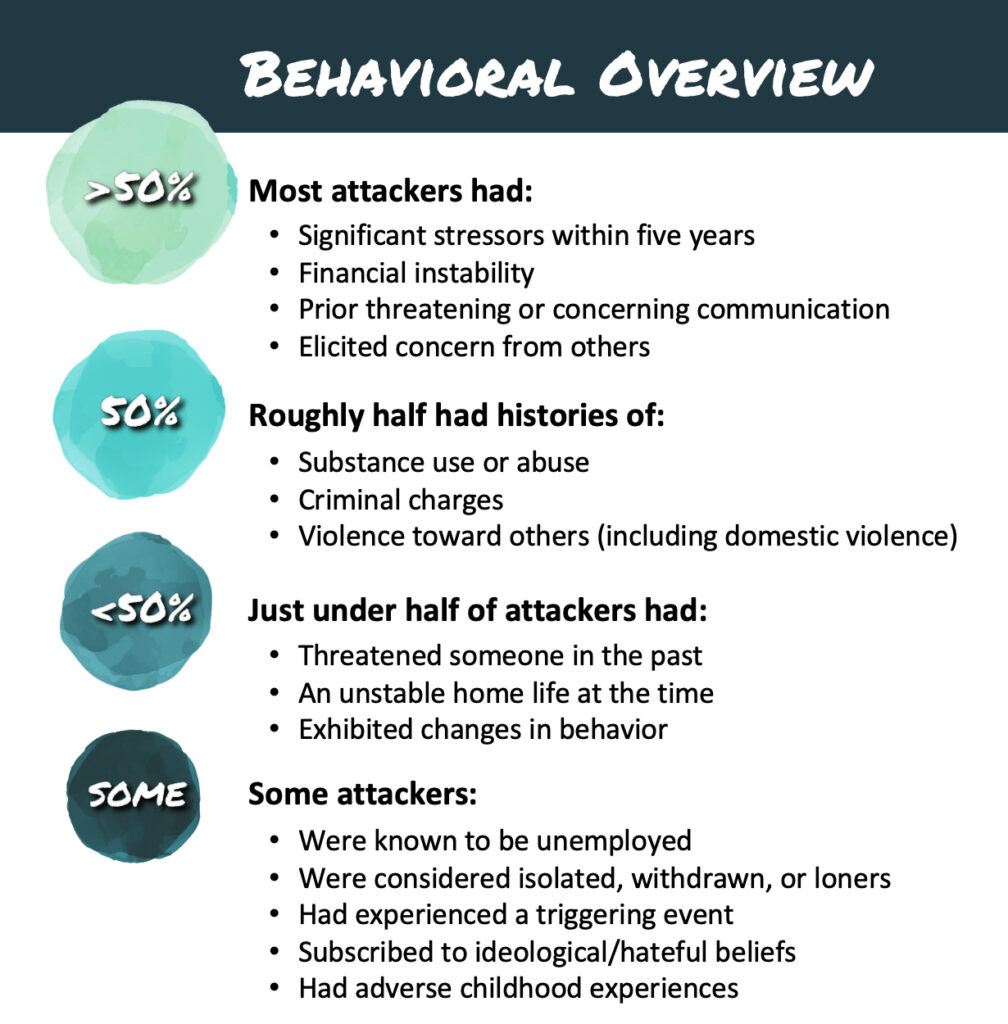
Key Findings Recap
These findings show that many attackers had experienced negative home-life factors, unemployment, substance use, mental health symptoms, or recent stressful events, and that many also had prior criminal histories. Obviously, these are very common experiences in the general population. Nonetheless, these are factors clinicians should be listening for when conducting assessments or considering when developing prevention strategies.
Suggestions
To address these concerns, the U.S. Secret Service suggests the following:
- Establish threat assessment programs, which we will discuss in a later module
- Enforce existing firearm laws
- Provide crisis intervention, drug treatment, and mental health treatment
- Recognize the risk of crime and violence
- Encourage the reporting of concerning behavior