
Trauma and Violent Extremism
Related to the focus on mental health, several sources point to possible associations between trauma and violent extremism, which is a subset of targeted violence.
The aforementioned PIRUS study found strong positive correlations between mental illness, substance abuse, trauma, pre-radicalization crime and acting alone.
Predictors of Violent Extremism Behavior
A recent Campbell Review identified “experienced violence”, “abused”, and “bullied” as significant predictors of violent extremist behavior. The sections below summarize these findings.
Socio-demographics
Protective Factors
- Immigrant (-.22)
- Age (-.08)
- Socio-Economic Status (-.03)
- Education (-.03)
Risk Factors
- Religious Convert (.15)
- Student (.11)
- Gender (.10)
- Unemployed (.06)
Attitudinal
Risk Factors
- Radical Attitudes (.48)
- Activist Intentions (.44)
- Commitment to Cause (.43)
- In-Group Superiority (.37)
- Perceived Discrimination (.37)
- Collective Relative Deprivation (.36)
- Perceived Injustice (.28)
- Anomia (.25)
- Low Integration (.20)
- Individual Relative Deprivation (.14)
- External Efficacy (.09)
Psychological/Personality
Protective Factors
- Openness (-.16)
- Conscientiousness (-.13)
- Agreeableness (-.12)
Risk Factors
- Identity Fusion (.52)
- Obsessive Passion (.50)
- Negative Affect (.47)
- Anger (.40)
- Symbolic Threat (.29)
- Realistic Threat (.26)
- In-Group Identity (.25)
- In-Group Connectedness (.23)
- Power-Distance Orientation (.23)
- Dark-Triad (.20)
- Self-Esteem (.20)
- Harmonious Passion (.16)
- Positive Affect (.16)
- Extraversion (.12)
- Significance Quest (.11)
- Social Dominance Orientation (.09)
- APD/Narcissism (.08)
- Neuroticism (.07)
- Uncertainty (.05)
Experiential
Risk Factors
- Past Activism (.33)
- Experienced Discrimination (.06)
Criminogenic
Protective Factors
- Outgroup Friends (-.10)
Risk Factors
- Moral Neutralization (.36)
The significant associations between “experienced violence,” “abused,” and “bullied” mean that these factors should be considered in risk assessments, but they should not be considered either predictive or necessary for a given case.
Childhood Risk Factors
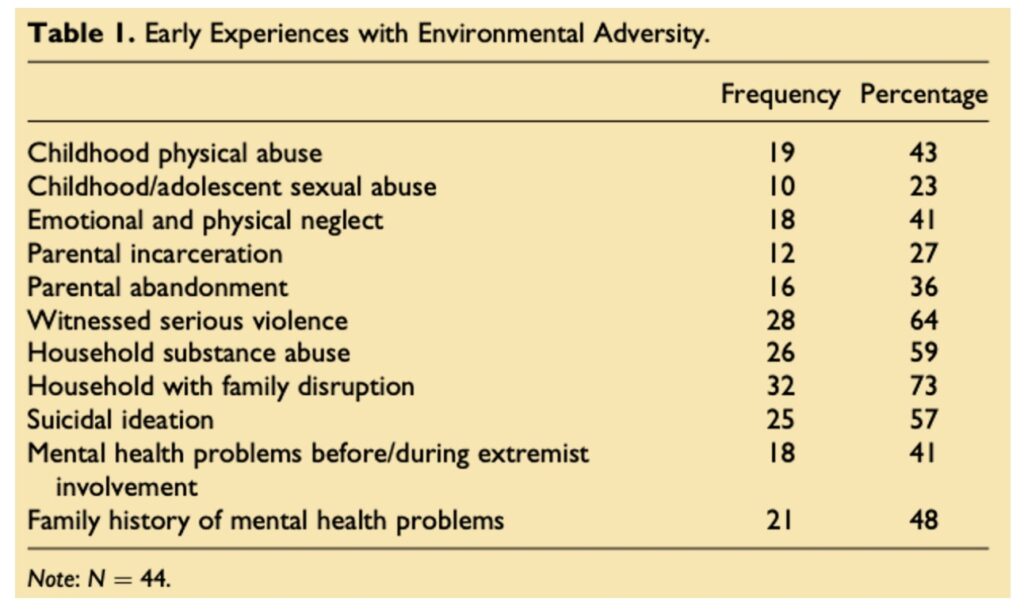
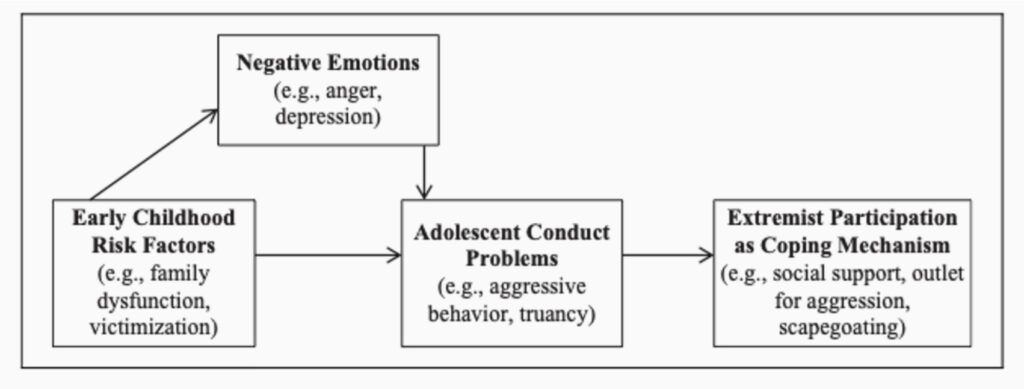
The researcher Pete Simi et al. conducted in-depth life-history interviews with former members of violent White supremacist groups which documented: “childhood risk factors as a series of destabilizing and adverse conditions that dovetailed with adolescent misconduct.” Specifically, childhood risk factors and adolescent conduct problems were present as precursors to participation in violent extremist groups.
Constant Traumatic Elements
Daniel Koehler et al wrote the following on another dimension of the possible relationship between trauma and violent radicalization:
“It is argued here that not only the salient features of membership in extremism automatically contain significant risk factors for physical and mental wellbeing, but also that a core mechanism of violent extremist radicalization processes is to combine constant traumatic and therapeutic elements to foster commitment and embeddedness into the extremist milieu. This mechanism, it is proposed, holds serious potential for mental health damage especially for young and adolescent individuals and should be considered as a form of child abuse in itself.”
For example, some extremist organizations may make young persons witness or participate in violent actions.